Part of everyday life in hospitals and ambulance services since 2018
since 2018
in use, developed in Basel, presented at HIMSS in Las Vegas
over 1 million
shift changes managed at short notice
4.6 out of 5
stars in the app stores — from people who were handed the app by their employer
over 100
ambulance stations organise their shifts with it
The problem
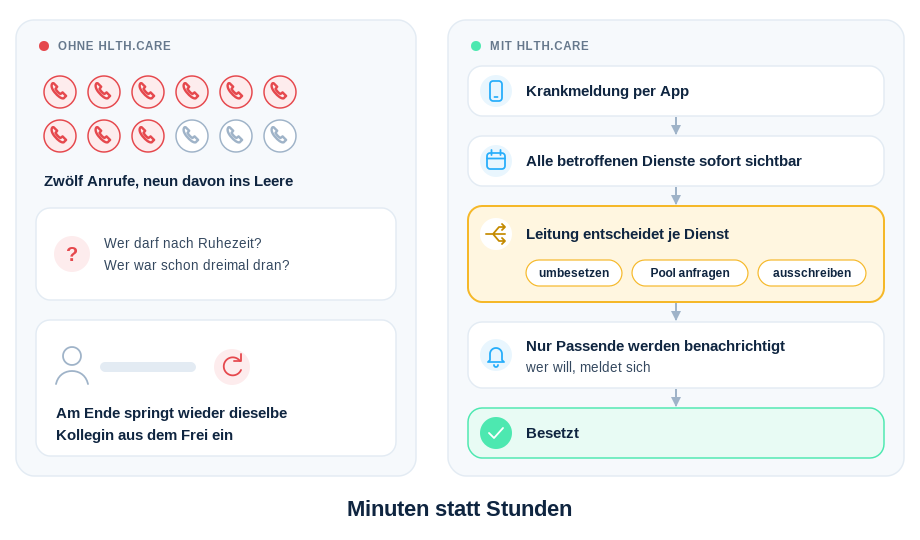
Twelve calls, nine unanswered — and the same colleague steps in again
Who is available? Who is out of rest time? Who has already covered three times this month? No rostering system was built for these questions. So the absence runs through phone lists, WhatsApp groups and the goodwill of a few individuals.
HLth.care organises that moment. The sick note arrives by app, every affected shift is there at once, and an open shift goes to everyone who fits — not to the three whose numbers you know by heart. Whoever wants to, responds. Whoever does not, does not get a call.
The principle
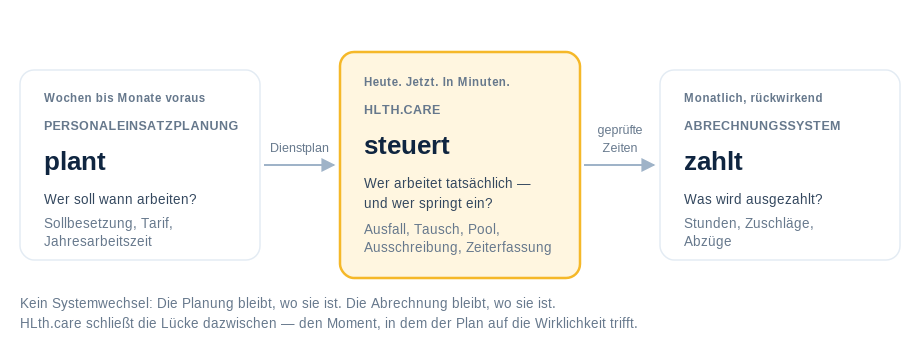
The rostering system plans. HLth.care steers. Payroll pays.
Rostering works in weeks, absence management in minutes. HLth.care does not replace your workforce planning; it closes the gap between the plan and what actually happens. What that means in detail
What the system does
Tools for the moment the plan stops being right
Absence management
Sick note by app, every affected shift visible at once, one decision per shift: reassign internally, raise a pool request or tender it.
Pool Management
Raise a pool request, assign, make the assignment visible — across hospitals too.
Shift tenders
Offer open shifts internally, across sites or externally.
Shift exchange
Exchange shifts between colleagues, with approval if wanted.
Individual shift times
Not staying away altogether, but coming in half an hour later.
Essential Board
Who is on duty right now? The emergency roster on the screen in the emergency department and at the switchboard — current, with nobody maintaining it.
Time recording
Clocking in and out on shift, monthly approval, a verified export to payroll.
Travel nurses
Assignments from one day, in the same flow as internal shifts.
Team communication
A chat per team, files, broadcasts — instead of a WhatsApp group.
Finding support
Who speaks Turkish, who knows the device — and is on duty right now?
How an absence runs
From the sick note to the covered shift
- 1
The report arrives
By app, with the period. Nobody has to phone, nobody has to copy anything out.
- 2
The shifts are there
Every affected shift at a glance, without hunting for them.
- 3
The lead decides
Per shift: reassign, raise a pool request or tender it. Rest time and weekly working time are checked.
- 4
The right people hear about it
Only those who fit and are free are notified. Assigned with one click.
Who it is for
The same software, something different for every role
Executive management
Lower absence costs, measurable processes, an argument in the competition for staff.
Director of nursing
A pool that really works, and an overview of every ward.
Ward and team lead
This morning’s absence, settled before handover.
Staff
Your own roster in your pocket, exchanging shifts without begging.
Ambulance services
Open shifts visible to every station, preferred shifts instead of a spreadsheet.
Elderly care
One shared staff pool for the facilities of one provider.
IT and data protection
No server, no installation, a data centre in Germany.
Staff representation
Traceable rules instead of arrangements in the corridor, with an approval role of its own.
Procurement
Published prices, billing by actual use, no software purchase.
A rollout without an IT project
Ready in days, not months
No migration, no data transfer, no legacy system to switch off. Process and effort · Pricing
- 1
Workshop on site
Two days of consulting on processes, roles, pool and absence, with your leads.
- 2
Set up and train
Configuration, training for leads, the app for everyone. The employer creates the accounts.
- 3
Go live
You pay per month and per actual user — the more users, the lower the price.
Why we do this
We give healthcare staff time for care back.
Every minute that does not go into coordination belongs to care. HLth.care did not come out of a software house but out of nursing practice. About us · Facts and figures
See it rather than read about it
Show us your last absence. We will show you how it runs with HLth.care.
In a no-obligation live demonstration, on your own example. A reply within 24 hours.