Where we come from
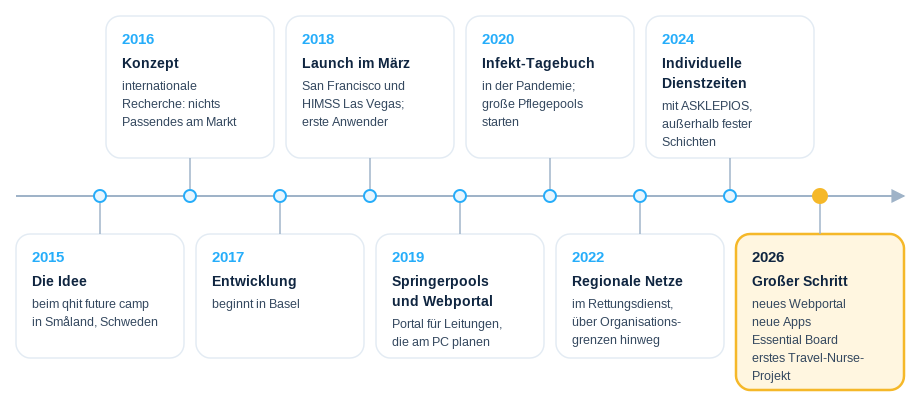

The idea came up in 2015 at the qhit future camp, an annual gathering of international nursing experts in Småland, Sweden. The question there was simple: where in everyday nursing is the most time lost that nobody planned for? The answer was finding cover when someone drops out.
In 2016 an international search showed there was no suitable software — the only usable solution was built around the processes of the British NHS. Instead of handing the concept to a software house, qhit healthcare consulting set up its own development team in Basel, where clinical experience and technical skill work side by side.
Development began in 2017. In March 2018 the apps for Android and iOS were first presented, at the launch in San Francisco and at the HIMSS Global Conference in Las Vegas. The first users followed the same year. The system has been in use ever since and is developed further several times a year.
What has grown since
Almost everything HLth.care does today came out of a specific requirement from a hospital:
- 2019 — pools and the web portal. Hospitals increasingly organised absences through central pools. A portal followed for the leads who plan at a PC.
- 2020 — the Infection Diary. Built during the pandemic for hygiene officers and still in use. In the same year a pool serving five hospitals of one group, with more than 600 pool staff, went live. From 2021 a vaccination centre organised the shifts of 650 staff entirely around their preferred shifts.
- 2022 — across organisational boundaries. An ambulance service in a large city brought in the stations of the surrounding municipalities — a regional network in which shortages are carried together.
- 2024 — individual shift times. A programme for self-determined working with ASKLEPIOS produced working times outside fixed shifts. → Individual shift times
- 2025 — co-determination from the start. Works councils and data protection officers are part of every project, with agreements worked out together.
- 2026 — a big step. A completely new web portal, new apps, the Essential Board and the first travel nurse project in Germany. → What’s new
What we stand for
- Time for people. We measure ourselves not by features but by the time that flows back into care.
- Close to everyday work. Development is not outsourced; nursing experience sits at the table.
- Self-determination. Staff help shape their working time and decide for themselves what others see about them.
- Transparency. Our prices are published, and critical questions from staff representation and data protection are welcome.
- Reliability. A message that does not arrive is a gap in care. We stay on problems like that until they are solved.
- Together, not alone. Pools and networks across wards, sites and organisations.
- Complement, not displace. HLth.care fits into your system landscape. The choice stays with you.
Who is behind it
The healthcare specialists at qhit healthcare consulting, Basel, have handled the transfer into practice from the start. Founder and head consultant is Guido Burkhardt — a pioneer of digitally supported work in healthcare since the early 1990s, with his own practical experience as an advanced practice emergency nurse, interim manager and digital health professional.
This is not a software house that discovered an industry, it is nursing practice that built itself software.