How it usually goes today
The sick note comes by phone, often to the ward, sometimes to the lead’s private number. Someone writes it on a slip of paper. Then the search begins: who is off? Who was on nights yesterday? Who is still inside their rest time? Who has already saved the day twice this month? Calls follow, and call-backs, and WhatsApp messages in a group that also carries holiday photos. In the end the one who always steps in steps in — until one day she does not.
How it goes with HLth.care
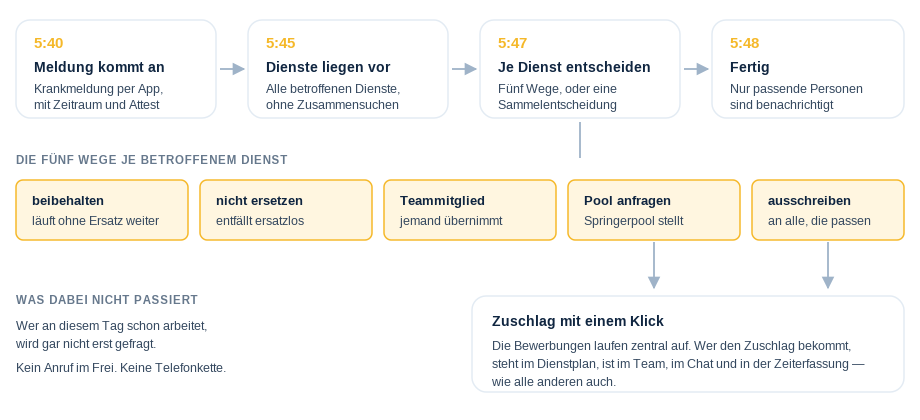
1. The notification arrives digitally. The member of staff reports herself absent in the app: pick the period, photograph the doctor’s note, send. The organizers know immediately, and HR gets the note in a list of its own.
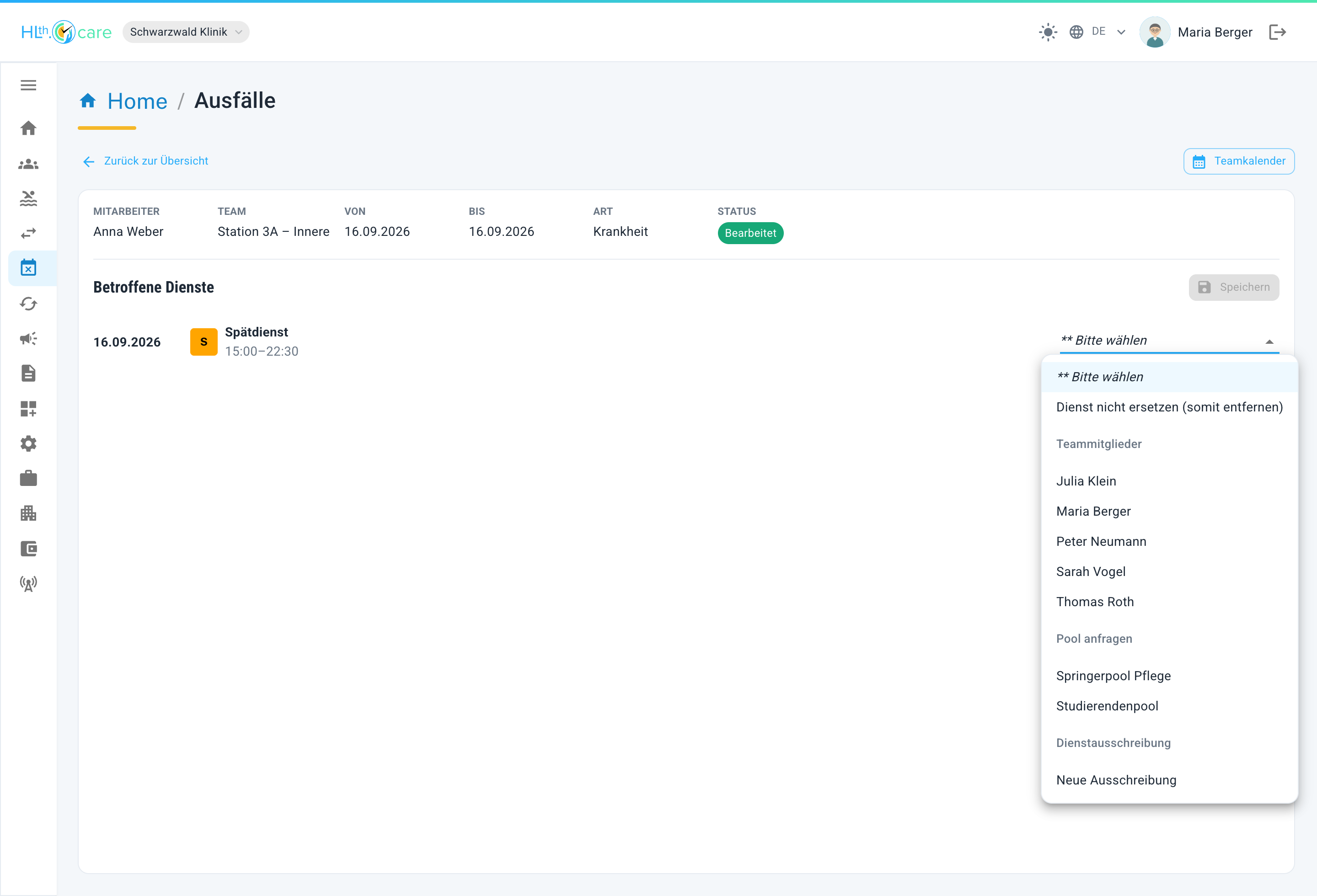
2. The affected shifts are on the table. The lead opens the absence and sees every shift affected in that period — with date, shift type and time. Nothing has to be pieced together.
3. A decision is made per shift. For each affected shift there are exactly five routes:
| Decision | When it is the right one |
|---|---|
| keep | The shift runs on without a replacement — the staffing carries it anyway |
| do not replace | The shift is dropped with nothing put in its place |
| assign to a team member | You already know who will take it |
| ask the pool | A staff pool supplies someone |
| shift tender | The shift is opened up for applications |
A bulk decision applies the same route to all of a day’s open shifts at once.
4. The rest happens by itself. Whoever is asked gets a push notification. Whoever is already working that day is not asked at all. Whoever has applied appears in the list. One click awards the shift — the person is in the roster and in the team.
5. Reporting fit again closes the case. Whoever can come back earlier reports herself fit in the app; her own shifts return to the state they were in before.
What you gain
You ask the right people. Anyone who already has a shift that day is not asked — the system knows. Qualification and department can be passed along with the request.
You ask everyone at the same time. Not one after another, not by who you get on with, not by whose number you happen to remember. Whoever wants it says so; whoever does not has nobody to let down.
You can see what you decided. Every absence is a case with a status. At the end of the month what happened is traceable — for staff representation too.
Your staff are disturbed less. No call on a day off that ends in a guilty conscience.
What you should honestly know
An absence stays one case, however long it lasts. A four-day sick note is a single line 14.09.–17.09. with all the shifts of those four days underneath it: one detail page, one bulk decision, one save. A six-week sick note is one case too. Decisions are still made per shift — on day three you often need different cover than on day one — but you make them in one place instead of four.
There are two dividing lines. A case always belongs to one team (someone with shifts in two teams on the same day produces two cases), and a gap divides — Monday, Tuesday and Thursday are two cases.
A sick note is a sick note. There is no holiday request and no approval for days off in HLth.care. Planned absence is a shift type and is entered like any other shift. That is deliberate: an application process for holiday belongs in the planning system, not in ad-hoc steering.
Data protection at a delicate point
As soon as the absence has been decided, the marker disappears from the team calendar in the app and from the display screens. Colleagues therefore do not permanently see who was ill — while the gap is open it is team information; after that it is health information. This rule goes back to a requirement from the data protection officers of two large providers. On the lead’s own screens the case stays visible.