Three reaches, one decision
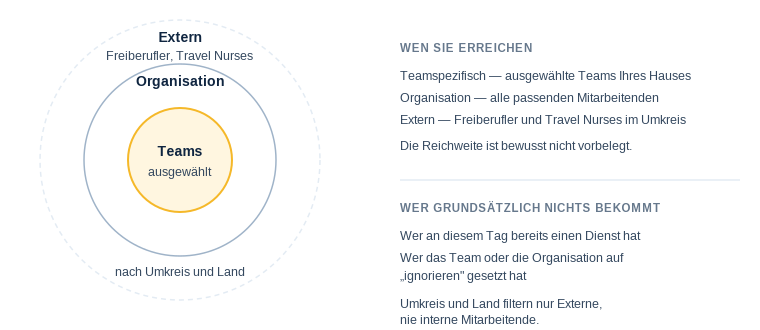
When you raise a tender you set who the shift reaches:
| Reach | Who is approached |
|---|---|
| Team-specific | selected teams in your hospital |
| Within the organisation | every suitable member of staff in your organisation |
| External | freelancers and travel nurses within the chosen radius |
Optionally alongside: professions addressed, skills required, an hourly rate and additional information.
The reach is deliberately not preset. It is a decision with cost consequences, and it should be taken deliberately.
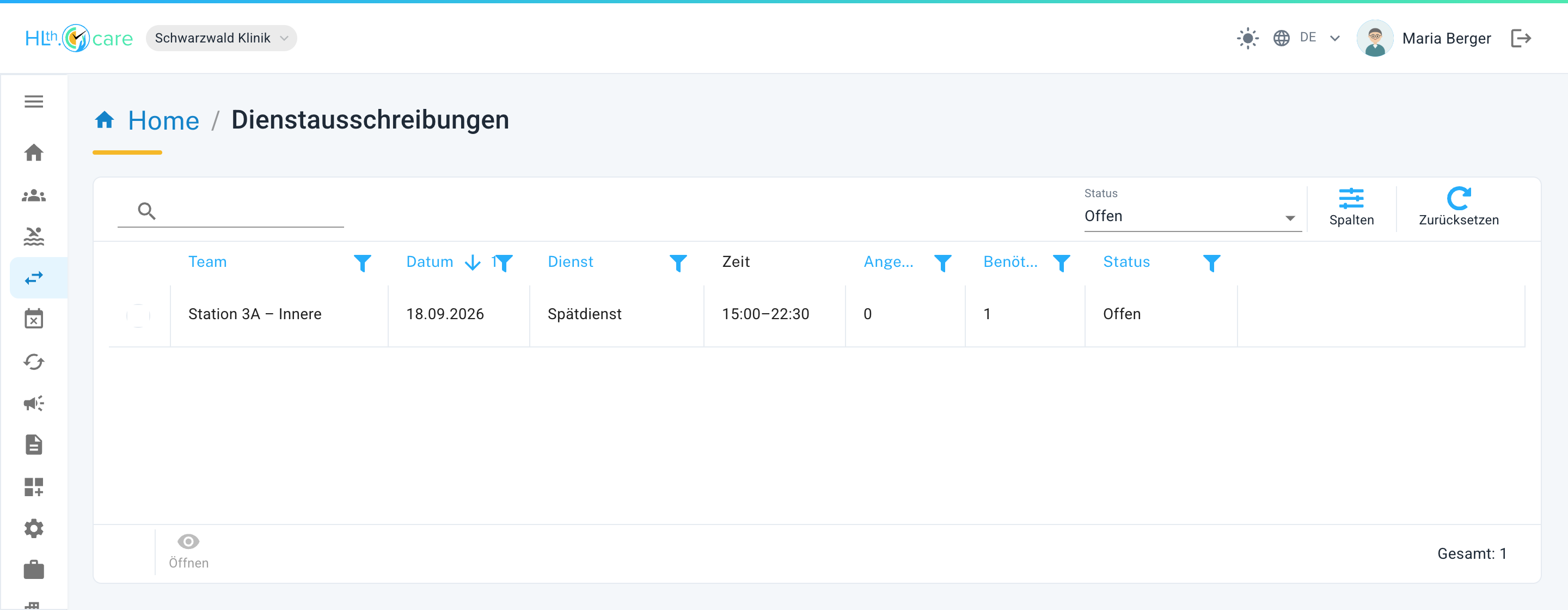
Who receives the tender
This is the question asked most often in practice — and the answer is where the real value of the feature lies:
- Anyone who already has a shift that day is not asked. Two exceptions: on-call duty does not count as occupied, and your own shift offer that has not yet been approved does not block you.
- Anyone who has set the team or the organisation to “ignore” gets nothing. The decision not to be asked sits with the member of staff.
- Radius and country filter external freelancers only. Internal staff are never affected by them.
The result: you reach more people than you would by phone, and disturb fewer.
Straight from an absence to a tender
The most common route does not go through the tender page at all: in absence management, new tender is one of the decisions available per shift. One dialog, one click, and the shift is out — with shared terms for several shifts at once.
Awarding the shift
Applications collect in one place. You see who has applied and award the shift. The person then appears in the roster and in the team as though she had always been there — chat and time recording included.
You can accept several applicants if you need several people. The rest are only declined when the tender is closed.
What you should honestly know
- Anyone who applies gives up her own shift offer for that time window — and gets it back if she is not awarded the shift. If the shift is by then in the past, it does not come back.
- Declining the last applicant does not return the shift. The tender stays open for others — that is intended.
- An expired or closed tender reopens the underlying absence. You then have to decide again.