In a hospital three systems work on the same working time, and each has a job the others cannot do.
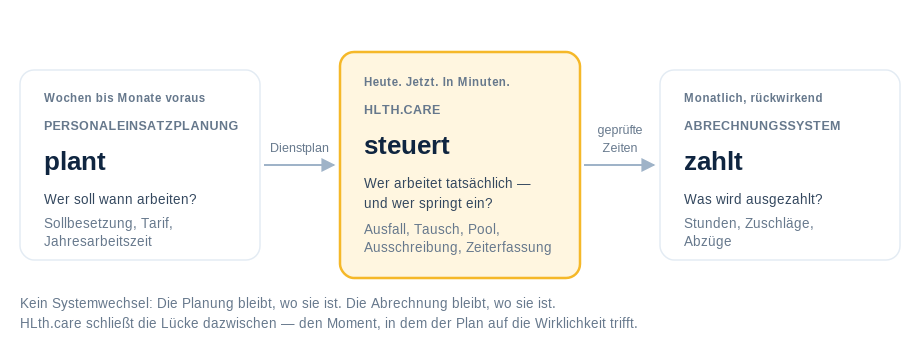
The division of labour
| Workforce planning | HLth.care | Payroll | |
|---|---|---|---|
| Job | plan | steer | pay |
| Horizon | weeks to months ahead | today, now, in the next few minutes | once a month, in arrears |
| Core question | Who should work when? | Who is actually working — and who steps in if they are not? | What gets paid out? |
| Works with | target staffing, pay scale, annual hours | absences, swaps, pool, short notice | hours, supplements, deductions |
| Serves | the planners | the ward, minute by minute | the HR department |
The gap is in the middle. A roster is out of date the moment it is published. Someone falls ill. Someone wants to swap. A slot stays open. That is exactly where HLth.care starts — and at the end of the month it hands the hours actually worked to payroll.
What that means in practice
Your rostering system stays the system of record for planning. Rosters can be imported from the planning system and appear in HLth.care as perfectly ordinary shifts — in the app for staff, in the team calendar for organizers. You keep planning where you have always planned.
HLth.care takes over from the moment the plan meets reality. A sick note arrives through the app at 5:40. The ward lead sees it at once, sees which shifts are affected, and decides per shift: cover internally, ask the pool, or put it out to tender. No phone chain, no waiting for a call back, no list.
Payroll ends up with numbers it can rely on. Clock-in and clock-out entries, automatic break deduction under your own house rules, the lead’s corrections, the month’s approval — and from that an export with four sheets that HR takes forward.
HLth.care does not do payroll. It supplies the verified times your system pays from. That is not a gap, it is the division of labour: payroll is a discipline of its own, with its own checks, its own liability and its own deadlines.
Why that makes the rollout easy
Because nobody has to give anything up.
- Planning loses neither a system nor a responsibility.
- HR keeps its payroll system and gets better data going into it.
- IT does not get a second core application, it gets a cloud service with no local installation.
- The ward gets the tool it has been missing.
Replacing a system is a project. Adding one is a decision.
And if we have no planning system at all?
Then it works without one. Smaller organisations, ambulance services and individual departments keep their roster directly in HLth.care — the team calendar can take shifts in exactly as it takes them from a third-party system. The only difference is where the planning happens, not how it is steered.