Not a prototype
since 2018
In use, first shown at the HIMSS Global Conference in Las Vegas.
over 1 million
short-notice shift changes managed in the platform behind the board.
4.6 out of 5
stars in the app stores — rated by people who were handed the app by their employer.
every 5 minutes
the board refreshes itself. No click, no sign-in, nobody watching over it.
What changes
- Every duty in every department, in one place, at a glance
- No more maintaining standby and emergency rosters by hand
- No more emails, spreadsheets or printed notices
- Immediate transparency across departments — and with it, faster action in an emergency
- Unfilled duties stand out while there is still time to fill them
- No additional licence cost while HLth.care is running
- As many boards with different contents as you like — per site, per department, per control room
What carries the board
Cloud from Germany
Run in a data centre in Germany certified for the purpose. You need no server of your own, no database and no software rollout — a computer with a screen and an internet connection.
An app for the people on duty
With “HLth.care Team” doctors and nurses report sick, swap shifts and see their roster. Free for your staff, in both app stores.
Updates in real time
What changes in the roster changes on the board. What is on screen is not last night’s plan but the situation right now.
Absence management behind it
The board shows the gap. The platform helps close it — with decline lists, a staffing pool and shift postings instead of a chain of phone calls.
Who is on duty right now?
That is the one question the Essential Board answers in seconds. Not in three clicks, not after signing in, not after a training session.
Why the Essential Board is different
We are not another rostering tool. The board is a clinical information screen, built for the moment when a correct piece of information matters. It runs wall-mounted in emergency departments, intensive care units, theatre areas and switchboards — exactly where that information is needed.
Where other systems aim at planning, the board aims at visibility of the actual situation:
- Real-time display of past, current and upcoming duties
- Immediate visual warning for unfilled duties
- No interaction required — no clicking, no searching, no training
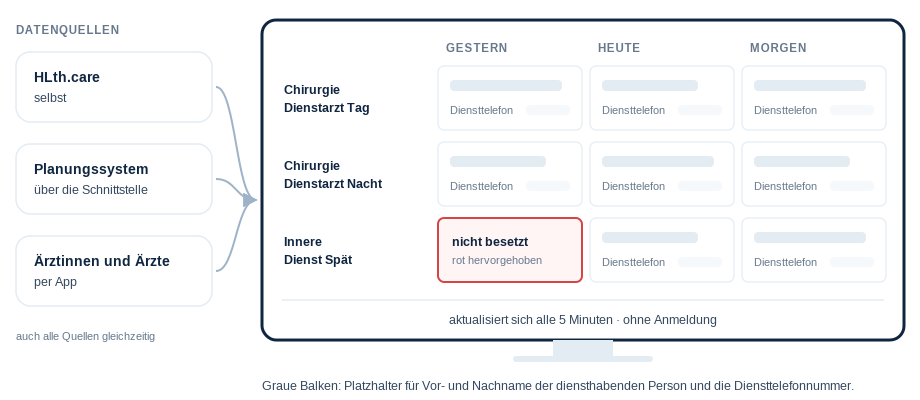
And it does not stand alone: the data comes from the HLth.care web software, from the mobile app and, if you want, from your existing planning system. It works with employed doctors just as well as with locums and on-call specialists — with no IT project and no infrastructure on site.
The Essential Board was not invented in a meeting room. It came out of working in an emergency department. That is why it looks different from what usually hangs on a hospital wall.
How it gets into the hospital
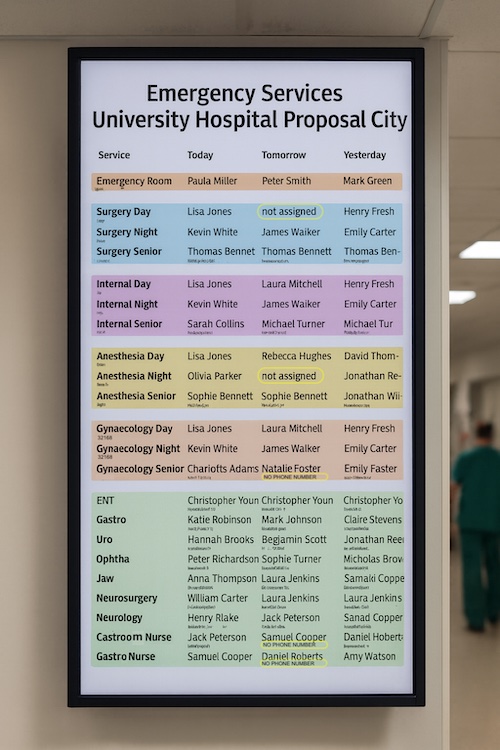
It is set up once, centrally: name each entry freely — “Surgery duty doctor, day” — record duty phone numbers or take them from the professional profile of the person on duty, and pick the source teams and shifts. After that it runs.
Typical locations: emergency department · switchboard · intensive care · theatre control · other central control rooms, including off site. For hospitals with cross-site emergency rosters a board can span several locations.
Each specialty additionally gets an info screen for its own duty room, showing the team’s complete roster — in real time, including the day’s changes.