Where the money is
Leadership time. A ward lead who spends an hour a day filling gaps costs you a quarter of a post over a year — and that hour is missing from leadership, not from administration.
Cost of absence. The later a shift is filled, the more expensive it gets. Anyone who can offer an open shift to every suitable member of staff within minutes reaches for agency staff and supplements less often.
Turnover. The reason most often given for leaving nursing is not pay, it is that the roster and life cannot be made to fit. Every resignation avoided saves a replacement — and induction time, which appears in no cost line anywhere.
Your own resources, unused. Staff pools, part-time employees with flexible allowances and colleagues on other wards are usually there. They simply are not found, because the search ends at the telephone.
A worked example
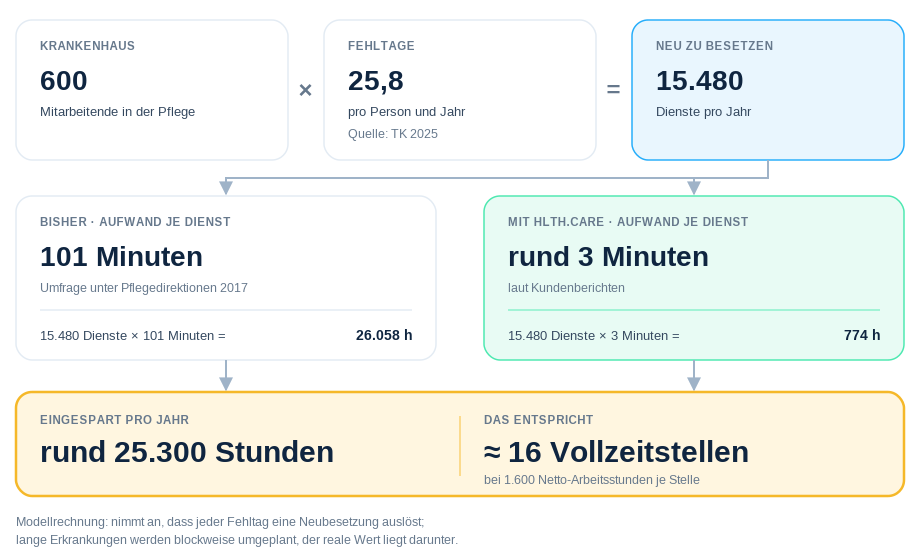
A hospital with 600 nursing staff, at 25.8 days of absence per person and year (Techniker Krankenkasse, 2025), has around 15,480 shifts a year to refill. According to a 2017 survey of directors of nursing, that took 101 minutes per shift on average; hospitals using HLth.care report around three minutes. The difference: around 25,300 hours a year, roughly 16 full-time posts that can flow back into care.
This is a model calculation, not a promise. It assumes that every day of absence triggers a refill; long illnesses are re-planned in blocks, so the real figure is lower. Do the sums with your own numbers — we are happy to help.
What it costs
Rollout project, flat price: €4,775. Two days of consulting on site, configuration and training for the system, the app and the info screens, system setup, plus a usage allowance for the first month at 100 users.
Operation: pay per use, on a sliding scale.
| Users | € per user and month |
|---|---|
| 1 – 50 | 2.25 |
| 51 – 100 | 2.00 |
| 101 – 250 | 1.75 |
| 251 – 500 | 1.50 |
| 501 and above | 1.25 |
No software purchase, no licence, no maintenance fee. Billed monthly and automatically on actual usage. The app is free for staff in the app stores.
Why this is not an IT project
HLth.care replaces neither your workforce planning nor your payroll system. It closes the gap between them.
The rostering system plans. HLth.care steers. Payroll pays.
That removes the most expensive part of any software decision in healthcare: the migration. Nobody gives up a system, nobody loses a responsibility, and there is no data transfer that can go wrong.
→ The division of labour in detail
What it gives you in the competition for staff
Two features can be used in a job advert, because they are held in the system and are therefore binding:
- Individual shift times — staff can offer times that differ from the standard shift instead of declining altogether. Hospitals report that contracted hours go up as a result.
- Less covering on days off — because open shifts go to everyone who fits, and not to the people who find it hard to say no.
What you do not get
So that you do not expect the wrong thing:
- No payroll. HLth.care supplies verified times to your payroll system. It is not one.
- No replacement for workforce planning. Long-term planning stays where it is.
- No holiday request with an approval workflow. Planned absence is entered, not applied for.
The next step
A no-obligation live demonstration on your own example — a real absence from the notification arriving to the shift being covered. After that you will know whether it fits your hospital.
support@hlth.care — we reply within 24 hours.