What you have to provide
For staff: nothing. The app comes from the App Store or Google Play and runs on private and work devices alike. Its storage footprint is negligible.
For the lead: a browser. The portal runs at app.hlth.care, with no plugin, no Java and no certificate rollout.
For an Essential Board: a computer with a screen and a link. The board is browser-based, runs on a timer and refreshes itself.
No terminal server publication, no software distribution, no patch cycle. Maintenance and updates happen in the cloud service.
Operation and location
The service runs from a data centre in Germany certified for the purpose. There is no local installation and therefore no component for you to back up, patch or add to your disaster recovery plan.
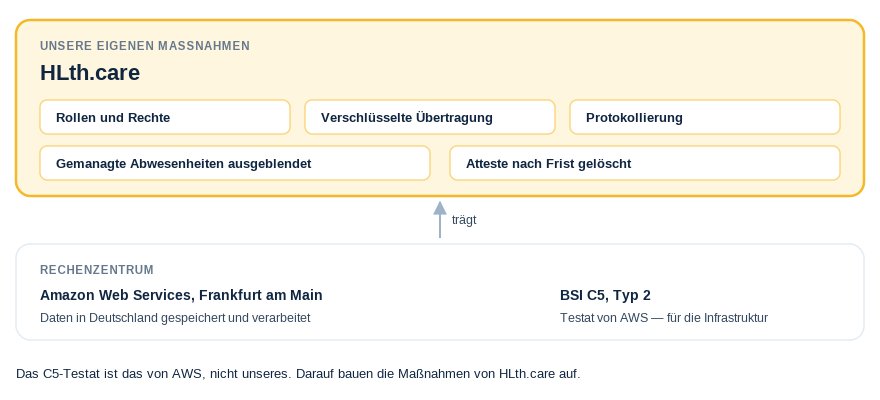
The data centre is that of Amazon Web Services in Frankfurt am Main. Data is stored and processed in Germany. AWS has this infrastructure audited every year against the C5 catalogue of the German Federal Office for Information Security (BSI), as Type 2 — which checks not only that the controls are designed correctly but that they actually work over a whole audit period. The attestation is AWS’s, not ours; it covers the infrastructure HLth.care runs on.
Our own measures build on it: data processing under a GDPR processing agreement, permissions through roles rather than individuals, encrypted transport between app, browser and server, logging — and the two rules under Data protection in practice below. We provide the technical and organisational measures under Art. 32 GDPR for your review.
The WhatsApp question
This is the underestimated part of the project. In almost every hospital, roster communication today runs through private messenger groups — with private phone numbers, sick notes and occasionally patient references, on private devices, in somebody else’s data centre, with no data processing agreement.
A team chat tied to team membership solves that not by prohibition but with a better offer: whoever joins the team is in it; whoever leaves is out. Nobody has to maintain a group, and nobody is left in one by accident.
Access and roles
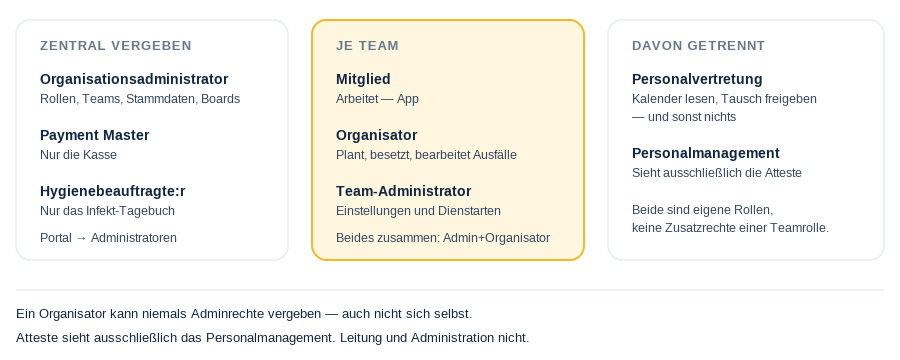
Rights hang off roles, not off people:
- Organisation roles are assigned centrally: administration, payment, hygiene.
- Team roles apply per team: member, team administrator, organizer, both.
- Special roles are separate from these: staff representation and HR management.
Two separations are drawn deliberately hard: an organizer can never grant admin rights, not even to herself. And doctor’s notes are seen only by the HR management role — not by the lead, not by administration.
One point to know when designing permissions: rights apply organisation-wide, not per team. Anyone who is an organizer in one team sees the organizer functions for the organisation. Plan roles sparingly accordingly.
Data protection in practice
Two points that go beyond general assurances and take effect in day-to-day operation:
Managed absences are hidden. As soon as the lead has decided, the marker disappears from the team calendar in the app and from the display screens — and that applies to every decision, including one where the shift has gone to a pool or into a tender and it is still open who will take it. While the gap is unaddressed it is team information; after that it is health information. This rule goes back to a requirement from the data protection officers of two large providers.
Doctor’s notes are actively removed. After the retention period set by the hospital the document is deleted; if HR management marks it as dealt with, that happens immediately afterwards.
Two things to plan for
The Essential Board is deliberately reachable without signing in — a screen in the emergency department cannot sign itself in. The link is therefore the access right: whoever has it sees names and duty phone numbers. An IP restriction can be set, but it is a filter and not a substitute for confidentiality. Withdrawing access means renewing the link — the old one is then dead, including on printed QR codes.
An account is signed in on only one device at a time in the app. That is deliberate, and it is the most common support case of the first few weeks. Put it in your internal FAQ — together with the qualification that the portal is exempt: app and portal at the same time are not a problem.
Interfaces
Rosters can be imported from a workforce planning system; the matching runs on the personnel number issued per organisation. For deeper connections to hospital information systems, ERP or time management, a REST API is available. Running the service without any interface at all is entirely possible — and is the usual starting point.