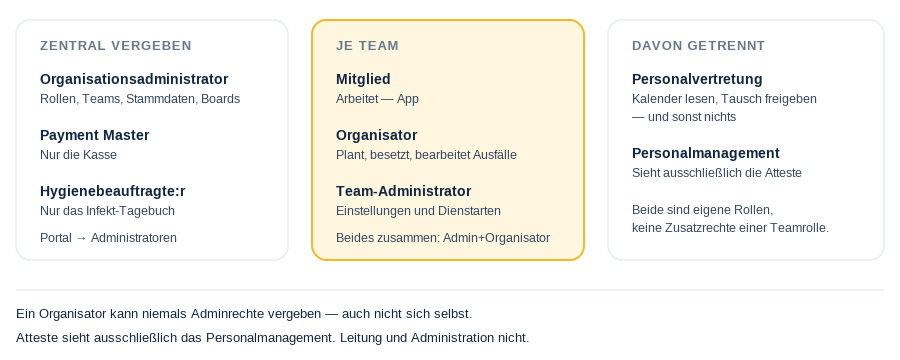
You get a role of your own
Staff rep is not a special permission somebody forgets to grant in HLth.care, it is a role of its own with exactly two powers:
- Read the team calendar.
- Approve or decline shift exchanges.
Nothing else. You do not plan, you do not see doctor’s notes, you do not change settings.
And: while approvals are outstanding, a staff rep cannot be removed from the team. That is enforced technically, not promised organisationally.
Approving a shift exchange
If staff representation is set up for a team, every exchange goes for approval after the people involved have confirmed it. Only then do the shifts change hands. For an exchange across two teams both sides have to approve.
You see who is swapping with whom, which shifts are affected, and whether a shift in return is part of it.
Approval by organizers can be switched on instead or in addition. Whether there is an approval at all, and who gives it, is a configuration decision per team — which makes it something that belongs in a works agreement.
What protections the system brings with it
Anyone who does not want to be asked is not asked. Staff can set a team or a whole organisation to “ignore” and then receive no more shift offers. The decision sits with them, not with the lead.
Anyone already working is not asked. A tender only reaches people who have no shift that day. That structurally limits how often somebody is approached.
Illness does not become a standing topic in the team. As soon as the lead has decided, the marker disappears from the team calendar in the app and from the display screens. That applies to every decision — including one where the shift is still with the pool or in a tender. Whoever steps in then appears in the tender row; the name of the person who was ill does not have to stay visible for that. This rule goes back to a requirement from the data protection officers of two large providers.
Doctor’s notes are seen only by those entitled to see them. The HR management role sees them — the lead and administration expressly do not.
What somebody has declared about her own working time is protected. An individual shift time the team member set herself cannot be silently overwritten by the lead.
An organizer cannot grant herself admin rights. Not even to herself. That is prevented technically.
What you should look at closely
These points belong on the agenda, not in the small print:
Working time recording is subject to co-determination. Whether it runs at all and in which mode — no recording, clock-in/clock-out, or with location recording — is a decision per organisation. The third variant records the location when clocking. That expressly needs to be agreed.
Corrections replace the original value. There is no side-by-side view of the clocked and the corrected time in the sense of a change history. If the traceability of corrections matters to you, agree the procedure.
Approving a month is final and cannot be undone. Agree by when staff can raise objections before an approval is given.
Rights apply organisation-wide, not per team. Anyone who is an organizer in one team sees the organizer functions for the organisation. How many people get that role is therefore a relevant question.
Keep the forms of employment cleanly apart. Core team, internal pool, travel nurse and freelancer are different arrangements. If your hospital works with external professionals, the agreement should say which shifts may go to whom.
The Essential Board is reachable without signing in. Whoever has the link sees the names and duty phone numbers of those on duty. For a screen in the emergency department that makes sense; who gets the link is still a question.
What expressly does not exist
No performance or conduct monitoring as a feature. There is no report that rates or ranks staff by willingness to step in, response time or declines. How often somebody has stepped in can of course be derived from the data — as it can from any roster. Agree whether and how that may be evaluated.
No holiday request and no approval of days off. Planned absence is entered like a shift. The holiday process stays where it is today.
The point that argues most strongly for the rollout
Today swaps and stepping in run through the phone, word of mouth and messenger groups. There is no rule that applies and no trail that can be checked — who gets asked depends on whose number the lead happens to remember.
With HLth.care the rules are explicit, apply equally to everyone, and are configured rather than grown. That is the real advance for co-determination.