Preferred shifts instead of a spreadsheet
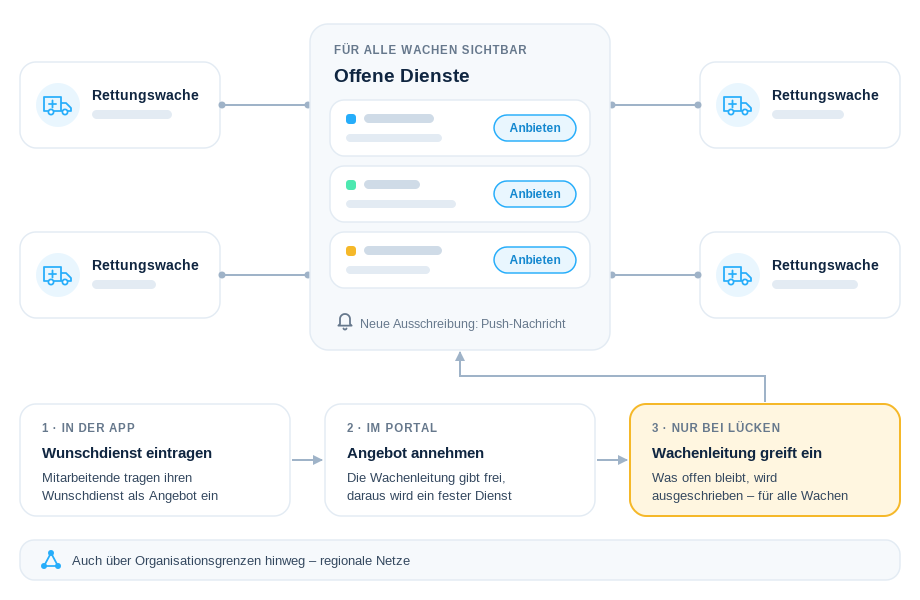
Staff enter the shift they would like to take themselves in the app — as an offer. The station lead accepts it. Whatever is still open after that, she tenders.
A station that works this way essentially no longer plans by itself: it only steps in where a gap remains. For staff that means fitting family and duty together better — and for everyone, that it is visible who has taken which shift.
Open shifts, visible to everyone
An open shift is tendered and appears for everyone who fits under Open shifts — with a push notification. Anyone who is already on duty that day does not receive the tender. Rest time and weekly working time are checked, as a warning to the lead.
Across stations and organisations
Since 2022 the ambulance service of a large city has used HLth.care together with the stations of the surrounding municipalities: a regional network in which shortages are carried together and available staff are deployed across sites.
Assessed independently — for ambulance services
In 2026 the Technische Hochschule Würzburg-Schweinfurt compared twenty rostering and workforce planning tools for ambulance services, measured against a reference service with six stations. HLth.care scored 76 out of 90 points, with the top mark for absence management, open shifts and Pool Management.
What HLth.care is not
Not a dispatch system and not a workforce planning system built from the ground up. Basic rostering stays where it is; HLth.care takes over everything that moves after that.